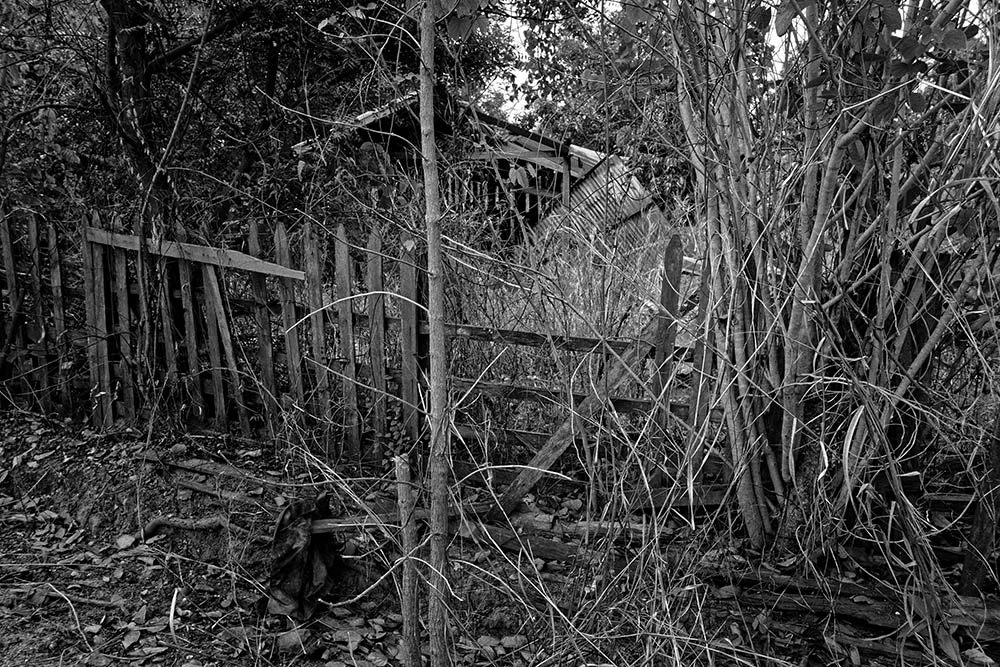
Behind an overgrown fence stands a family home left empty by conflict. It is also suspected to be contaminated by landmines. Until the danger is addressed, return remains impossible.
At first glance, it looks like a house that time has simply overtaken.
The fence is broken. Vegetation has grown wild across the yard. Trees and brush press in around the structure. What was once a home now feels swallowed by absence. But the reason no one has stepped back into this place is not only that the family fled. It is that the land around the house is suspected to contain landmines.
In villages affected by conflict in Myanmar, scenes like this are increasingly common. Homes stand abandoned not because families no longer belong there, but because return has become too dangerous. The places that once offered shelter and normal life are now surrounded by uncertainty. A yard, a doorway, a path to the kitchen, a patch of ground near the fence — any of these may conceal an explosive threat.
For displaced families, the desire to return is often strong. Home is not easily replaced. It is where people built their lives, raised children, planted crops, kept animals and planned for the future. But in heavily contaminated villages, return is no longer simply a matter of deciding to come back. It depends on whether the space itself can be made safe.
That is the challenge shown in this photograph.
This house is believed to be in a contaminated area. No one can safely enter unless clearance or other effective risk-reduction measures take place. Yet while the danger is known, the support needed to address it is often absent or delayed. In that gap, communities are left with impossible choices.
Local authorities or villagers may try to take matters into their own hands. They may attempt to inspect, clear or reopen the area without the equipment, systems or support required to do so safely. If they do, two outcomes are all too possible: someone is injured in the attempt, or a mine is missed. In the latter case, the danger does not disappear; it is simply hidden until the family returns and an incident happens later.
This is the cycle that practical landmine action must break.
Too often, contaminated homes like this are treated as part of a future problem — something to be addressed when the conflict is over, when access improves, or when large-scale formal clearance becomes possible. But families are not living in the future. They are making decisions now. They are weighing the hardship of displacement against the risks of return. They are waiting for some sign that it may once again be possible to go home.
This is why Community Safety Partnership argues that mine action cannot wait for ideal conditions.
Even when full clearance is not yet possible everywhere, there is still much that can and should be done to reduce harm. Hazardous areas can be identified and recorded. Communities can be supported to communicate where risks are suspected. Marking systems can be developed so danger is visible rather than hidden. Local authorities can be trained and supported to work more safely and systematically. Practical tools can be put in place to reduce the likelihood of both accidents and false confidence.
This is also why support to local actors such as KIEC is so important.
With a fraction of the cost of large external operations, local authorities and community-based structures can play a vital role in making return safer. They are already present. They know the terrain, the communities and the pressures families face. With the right support, they can help identify hazardous areas, improve reporting, promote marking, encourage safer behaviour and create the conditions for more structured future action. They cannot replace full humanitarian mine action, but they can help fill the dangerous gap between contamination being present and formal clearance eventually arriving.
That gap matters enormously.
For the family that once lived in this house, the difference between safe return and tragedy may depend on whether someone acts before they come back. If no action is taken, the house remains a place of memory but not of life. If untrained attempts are made, the risk may simply shift from one person to another. But if local systems are supported — if contamination is recognised, recorded, marked and managed more safely — then the possibility of return becomes more than hope.
This photograph shows a house without people, but it is not a story about emptiness. It is a story about what stands in the way of return, and about what can be done now to reduce that danger.
The issue is not only whether a mine is present. It is whether communities have the means to respond before a family pays the price.
Across Myanmar, many displaced families are waiting for exactly that. They do not need abstract promises. They need practical action that helps turn suspected danger into visible risk, and visible risk into safer return.
No family should have to guess whether the ground around their own home is safe. No village should be left to manage contamination alone. And no abandoned house should remain a silent warning of what happens when the threat of landmines is allowed to outlast the conflict that placed them there.
Behind every overgrown yard is a family that wants to come home.
The question is whether the world will help make that return safe.
“Supporting local authorities can make the difference between dangerous return and safer return.”