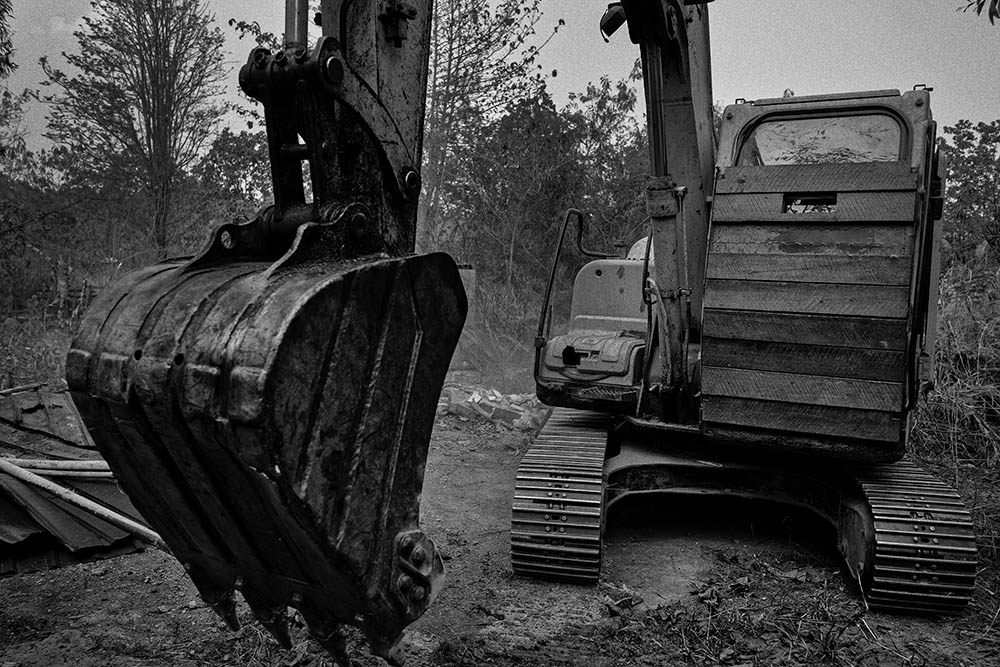
In a contaminated area of Myanmar, a machine adapted with makeshift armour is being used to help communities return. It is a sign of local determination — and of how much more support is needed.
The machine looks heavy, powerful and purposeful.
Its steel arm and bucket dominate the frame, suggesting control over difficult terrain. But a closer look reveals something else: improvised protection. Wood has been fixed around the operator’s cabin in an attempt to reduce risk while the machine is being used in an area affected by landmines and explosive ordnance.
It is a striking image, and an unsettling one.
This is not what proper humanitarian demining equipment looks like. The added shielding may offer some protection against a small anti-personnel mine, but it would provide little safety if the machine struck something larger, such as unexploded ordnance. If that happened, the person inside would remain dangerously exposed.
And yet the machine is being used because the work needs to be done.
This photograph captures both the determination of KIEC and the reality facing many conflict-affected communities in Myanmar. Villages want to return home. Families want to rebuild. Land that has been left abandoned needs to be reopened, checked and made safer. In the absence of sufficient formal mine action capacity, local actors are trying to respond with whatever means they can find.
That is what this machine represents.
It was made available through the efforts of a humanitarian worker who visited Myanmar on a different mission, saw the scale of the landmine problem, and decided to act. After returning home, he raised USD 50,000 and brought the funds back to support the hiring and use of the machine for clearance-related work.
That act of solidarity matters. It shows how quickly people understand the seriousness of contamination once they see it for themselves. It also shows that support for practical action is possible when the problem is made visible.
But the photograph also exposes a harder truth: communities should not have to depend on improvised tools and ad hoc solutions to make return possible.
KIEC is committed to helping villages. That commitment is real. Local actors are stepping forward because the need is urgent and because families cannot wait indefinitely for ideal conditions. In many contaminated areas, people are already making decisions about return. They are moving back to damaged homes, reopening paths, clearing vegetation and trying to rebuild livelihoods. Every delay in addressing contamination increases the chance that communities will take risks on their own.
This is where the distinction between risk reduction and full clearance becomes essential.
The machine shown here may be able to assist with certain tasks. It can help remove dense vegetation. It may help expose parts of the ground and support preliminary efforts to check whether hazards are present. It can contribute to making dangerous areas more accessible for further action. But it is not, by itself, a full clearance solution.
That matters because people returning to land that has not been properly cleared may believe an area is safe when it is not. A path may appear open, a house site may seem usable, and vegetation may have been stripped away — but hidden threats can remain. If those risks are not systematically identified, marked and addressed, returning families may settle on land that is still contaminated.
This is one of the greatest dangers in conflict-affected environments: not only obvious risk, but false reassurance.
The machine in this photograph therefore tells two stories at once.
The first is one of courage and commitment. Local actors are not standing by while communities suffer. They are using what resources they can find to help reduce danger and support return. KIEC’s willingness to act reflects the urgency of the problem and the strength of local leadership.
The second story is one of unmet need. Improvised armour should not be necessary. Local authorities should not have to rely on machinery not designed for safe mine action as a substitute for properly resourced systems. Families should not have to return to areas that have only been partially checked because more comprehensive clearance remains out of reach.
This is why Community Safety Partnership argues for practical, locally grounded support now — not only in the future.
Supporting local actors such as KIEC is one of the most effective ways to reduce immediate harm. With relatively modest resources, they can help identify dangerous areas, improve reporting, support marking, communicate risk and take practical steps that reduce the chance of accidents. They can also help ensure that local efforts are connected to safer systems and clearer pathways toward future formal action.
But support must be honest about what local tools can and cannot do.
The answer is not to romanticise improvised machinery or to confuse partial risk reduction with complete safety. The answer is to recognise both the value of local initiative and the urgent need to strengthen it. Communities need support that is safer, more systematic and more sustainable. They need resources, training, recording systems, marking approaches and practical risk-reduction tools that reduce reliance on dangerous improvisation.
This machine, armoured with wood, is a symbol of a much bigger reality. It shows what happens when communities are left waiting too long for the support they need. It shows the ingenuity and commitment of those trying to fill the gap. And it shows why international attention, funding and advocacy are so important.
People are not waiting for the conflict to end before trying to go home.
The question is whether they will return with proper support — or with only the thin protection of improvised solutions standing between them and the dangers still buried in the ground.