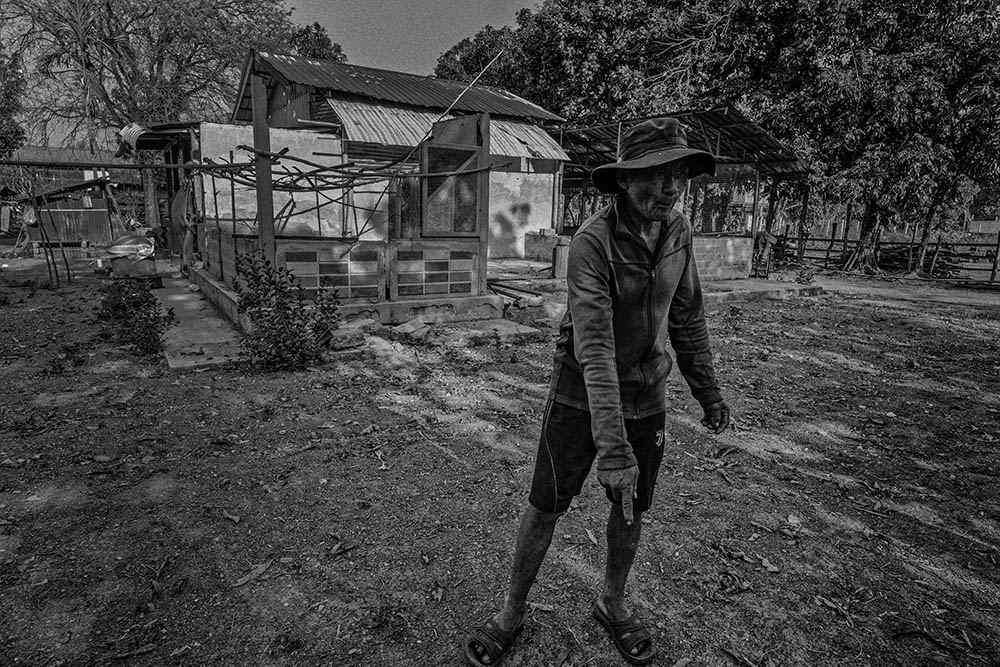
In a village trying to rebuild after conflict, one man helped clear houses for returning families. Then a neighbour stepped on a landmine he had not seen.
He points to the ground where it happened.
Behind him stands the house his neighbour’s family hoped to rebuild and return to. The structure is damaged but still standing. Like so many homes in conflict-affected parts of Myanmar, it holds the possibility of return, recovery and normal life. But the ground around it tells a different story.
This is where his neighbour stepped on a landmine.
In villages affected by conflict, return is rarely straightforward. Families do not simply come home to safety. They come back to damaged houses, abandoned fields, overgrown paths and a constant fear that the land itself may have been turned against them. In some places, contamination is so severe that whole communities remain displaced because the risks are too great. In others, people return anyway, driven by necessity, hope or the absence of alternatives.
The man in this photograph has tried to help his community face that reality.
As families began thinking about return, he took on the dangerous task of helping clear houses in the village so neighbours could rebuild. He worked around homes and yards, trying to identify obvious threats and make areas safer for those coming back. But in one case, a landmine was missed. When the returning family came back, his neighbour stepped on it.
That moment now defines the scene he is showing.
His story is not one of negligence. It is one of impossible responsibility.
No community member should be placed in the position of trying to make contaminated land safe without proper support, equipment or training. No family should have to depend on neighbours to search for hidden explosive threats around their home. Yet this is exactly what happens when communities are left alone in areas contaminated by landmines and explosive ordnance.
In many parts of Myanmar, formal mine action is not yet available at the scale needed. Access constraints, ongoing conflict, political sensitivities and insecurity all limit what can be done. But for the people who live with contamination, delay is not neutral. Life goes on. Families need shelter. Children need safe places to walk. Farmers need access to land. Neighbours help one another because there is often no one else to turn to.
That is why this photograph matters.
It captures the terrible gap between what communities need and what support is available. It also shows the burden that landmine contamination places not only on victims, but on those trying to protect others. The man standing here was trying to make return possible. Instead, he carries the knowledge that one mine remained hidden — and that someone paid the price.
This is the human reality behind abstract discussions of contamination.
Mine action is often understood in technical terms: survey, marking, clearance, explosive ordnance disposal. All of these are essential. But before any of that becomes possible, communities are already navigating danger. They are making daily judgments about where to walk, where to sleep, where to rebuild and whether it is worth the risk to return at all.
When those judgments have to be made without adequate support, the result can be tragedy.
This is why Community Safety Partnership argues that mine action cannot wait until ideal conditions exist. Where full clearance is not yet possible, practical steps must still be taken to reduce harm. Hazardous areas need to be identified and recorded. Communities need support to understand and communicate risk. Dangerous places need to be marked. Local leaders and volunteers need safer alternatives than informal self-clearance. And those who influence the use of landmines need to understand the long-term civilian consequences of every device laid.
The image also reminds us that contamination does not only prevent return — it distorts the very process of rebuilding. A family may have the courage to come home. Neighbours may rally around them. A house may still be standing. But one hidden landmine can undo all of it in an instant.
For communities affected by conflict, “return” is too often spoken about as if it were a single moment: the day people come back. In reality, return is a fragile and dangerous process. It requires not just shelter and supplies, but safety. Without that, every step towards home can carry risk.
The man in this photograph is showing more than a point on the ground. He is showing the cost of inaction. He is showing what happens when communities are forced to take on the burden of contamination alone. And he is showing why practical, community-centred advocacy is urgently needed.
Until communities have that support, stories like this will continue to shape return across Myanmar.
“The ground around a house can hold as much danger as the conflict that drove people away.”