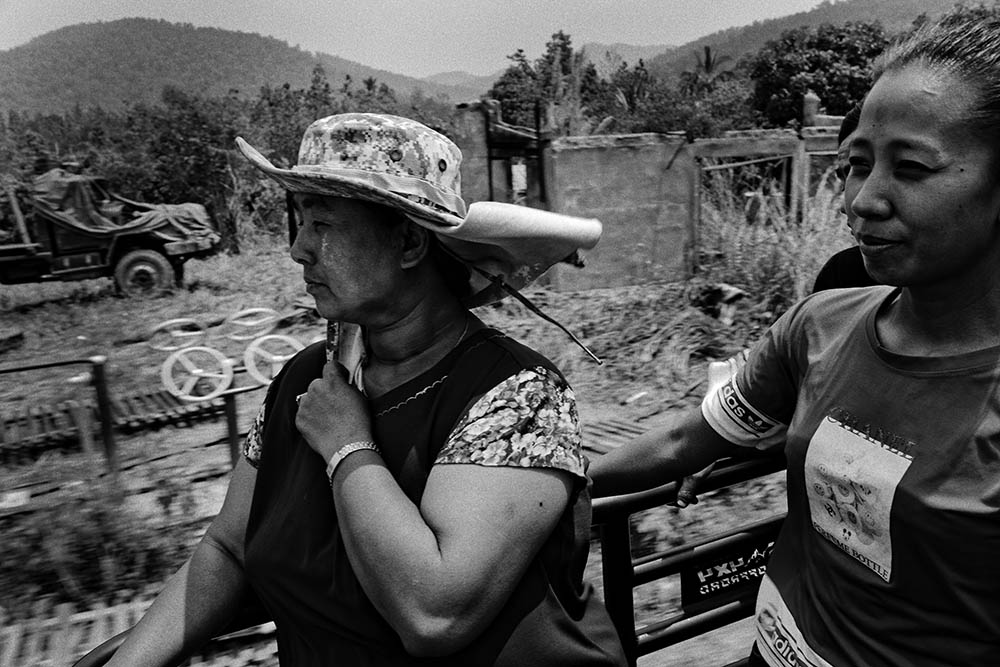
In a heavily contaminated village in Myanmar, one woman and her elderly mother were among the first to go home. Their return shows both the courage of affected communities and the urgent need for practical landmine risk reduction.
She was one of the first to go back.
After years of conflict, displacement and uncertainty, many families from her village still remain away from home. Some are living in temporary shelters. Others are waiting for news from neighbours, relatives or local leaders. Many want to return, but they know the danger has not gone.
The village is heavily contaminated by landmines and explosive ordnance. Houses have been damaged. Land is overgrown. Paths, gardens and familiar routes can no longer be assumed safe. For families who fled violence, return is not simply a question of whether they want to go home. It is a question of whether they can survive the journey back, rebuild safely, and live without stepping into danger.
The community leader in this photograph returned with her mother, who is in her eighties. Together, they began the difficult work of reclaiming their home. In the process, they found unexploded ordnance.
Their story is extraordinary, but it is not unusual in the way it reflects the reality facing many communities in Myanmar. Where formal mine action is not yet available, people are forced to make impossible choices. They can remain displaced, often with limited access to food, water, shelter and livelihoods. Or they can return to places they know may be dangerous.
Some people return because they need to farm. Some return because they have nowhere else to go. Some return because their home, land and identity are tied to that place. Some return because waiting is no longer possible.
But return can carry a terrible cost. In this village, people who have gone back have stepped on mines. Others remain too afraid to return. Families know that contamination may be hidden in the very places that once made ordinary life possible: paths, yards, fields, houses, gardens and areas around community buildings.
This is why Community Safety Partnership exists.
In contexts like this, mine action cannot wait for perfect conditions. Full clearance may not yet be possible. International access may be restricted. Political and security constraints may delay formal operations. But communities are already making decisions every day. They are moving, returning, rebuilding and taking risks because they have no better option.
Advocacy must start from that reality.
CSP works to reduce the use and impact of landmines and explosive ordnance by supporting practical, community-informed action. That means listening to people who know where the danger is. It means helping local leaders make risks visible. It means advocating for hazardous areas to be recorded and marked. It means engaging with those who can reduce harm. And it means pushing for pathways toward future survey and clearance when conditions allow.
The woman in this photograph represents more than return. She represents leadership in the absence of adequate support. She represents the courage of communities who are trying to survive in contaminated areas. She also represents the danger of leaving communities to manage landmine risk alone.
No one should have to clear their own home. No elderly mother should have to search for explosive ordnance so her family can return. No community should have to choose between displacement and danger.
Yet this is the reality in many parts of Myanmar.
The practical steps needed are not always complicated. Communities need accurate information. Dangerous areas need to be recorded. Hazardous places need to be marked. Local leaders need support. Armed actors and authorities need to understand the long-term civilian impact of landmine use. Donors and humanitarian organisations need to see what is happening on the ground, not only through statistics, but through the lived experience of people trying to go home.
This story is not only about one village. It is about the urgent need to act before more lives are lost.
Myanmar cannot wait for perfect conditions.
Communities are already returning. The question is whether they will be left to face the danger alone.