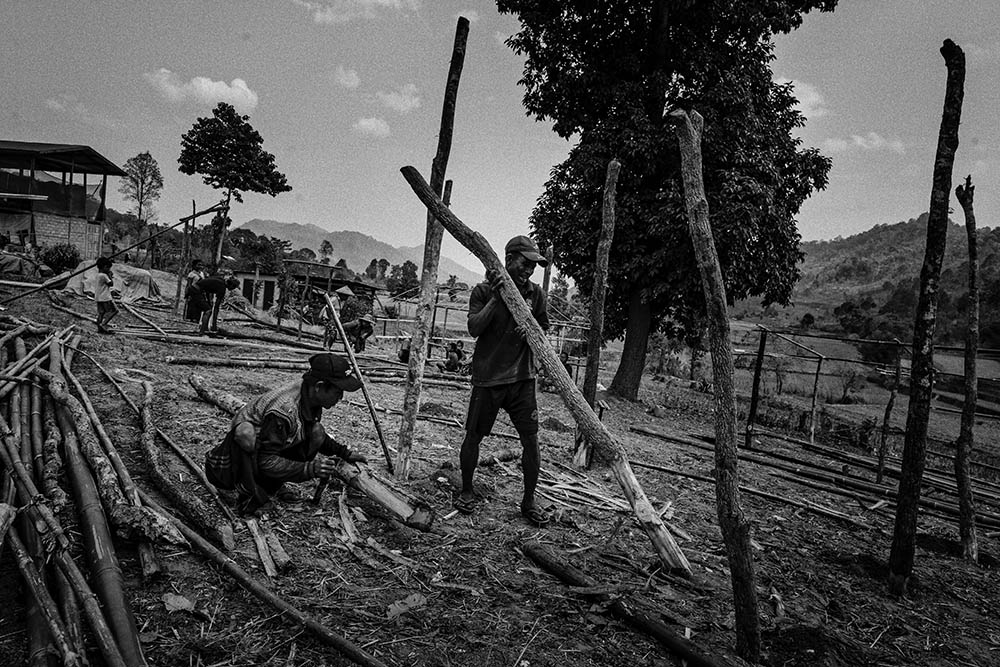
Families fleeing conflict in Myanmar have arrived in another village after repeated displacement. On the journey, people were injured by landmines and shelling. Even here, safety is uncertain.
They have moved before.
For many families displaced by conflict in Myanmar, flight is not a single event. It is a pattern repeated again and again: leave home, find temporary shelter, move when fighting comes closer, move again when food runs out, move again when shelling, airstrikes or landmines make the area too dangerous.
The people in this photograph have already been through that cycle multiple times.
After fleeing their homes, they arrived in this village quickly, carrying what they could and trying to settle into another temporary place. The conditions are difficult. Food is limited. Services are scarce. The future is uncertain. But the journey here was itself dangerous.
According to those who had recently arrived, three people were injured by landmines on the way. Four others were injured by shelling.
These are not abstract risks. They are the dangers that shape every decision: which path to take, whether to move at night or during the day, whether to stay in a place that feels unsafe or risk moving through land that may be contaminated.
For displaced families, landmines do not only threaten return. They also threaten escape.
People fleeing violence may have no reliable information about which routes are safe. Areas that were once familiar may have changed. Paths may have been mined. Fields may be dangerous. Forested areas, shortcuts, abandoned roads and the edges of villages can all become places of risk.
In this kind of environment, movement becomes a calculation made under pressure. Staying may mean exposure to shelling or fighting. Leaving may mean exposure to landmines. Neither choice is safe.
And yet what stands out in this scene is not only danger. It is the way people continue to organise themselves, care for one another and find moments of connection even in conditions of profound uncertainty.
Despite everything they have been through, there is still warmth here. People sit together. They talk. They share information. They look after children. They begin, again, the work of making a temporary place livable.
This should not be mistaken for resilience as a substitute for support. Communities should not have to survive repeated displacement, food shortages, shelling and landmine risk with so little protection. But their strength is visible. So is the urgency of acting before more harm occurs.
This is why Community Safety Partnership argues that landmine advocacy must focus not only on clearance after conflict, but on practical risk reduction during conflict.
Displaced families are already moving. They are already making decisions about routes, shelter, food and return. They need better information about risk. They need dangerous areas to be recorded and marked. They need local leaders and responders to be supported. They need those using landmines to understand that every device laid can shape civilian movement for years.
Mine action cannot begin only when everything is safe. By then, many families will already have paid the price.
The people in this photograph are not waiting for a formal response to become possible. They are trying to survive the present. They have fled, moved, arrived and started again. But around them remain the same questions: where is safe to walk, where can food be found, where can children move, and when — if ever — will home be safe enough to return?
Their story shows why advocacy matters.
Advocacy can push for restraint in the use of landmines. It can help make dangerous areas visible. It can support locally led risk communication. It can encourage marking and recording before information is lost. It can bring donor attention to the risks faced by displaced communities while conflict is still ongoing.
For families on the move, these practical steps can make the difference between danger known and danger hidden.
This is not just a story of displacement. It is a story of movement through risk. It is a reminder that landmines do not sit quietly in the background of conflict. They influence where people flee, how they travel, whether they can find food, and whether they dare to go home.
Even in this new place, safety is not guaranteed. But the people here continue to gather, adapt and support one another.
They have already moved too many times.
The question now is whether practical action can reduce the dangers that follow them wherever they go.
“Mine action cannot begin only when everything is safe. By then, many families will already have paid the price.”